Can Bert Vectors Be Used Outside of Bert
What is BERT?
BERT is a deep learning model that has given state-of-the-art results on a broad diverseness of natural language processing tasks. It stands for Bidirectional Encoder Representations for Transformers. It has been pre-trained on Wikipedia and BooksCorpus and requires task-specific fine-tuning.
What is the model architecture of BERT?
BERT is a multi-layer bidirectional Transformer encoder. There are two models introduced in the newspaper.
- BERT base of operations – 12 layers (transformer blocks), 12 attention heads, and 110 meg parameters.
- BERT Big – 24 layers, 16 attention heads and, 340 one thousand thousand parameters.
For an in-depth agreement of the edifice blocks of BERT (aka Transformers), you should definitely cheque this awesome post – The Illustrated Transformers.
What is the flow of information of a word in BERT?
A word starts with its embedding representation from the embedding layer. Every layer does some multi-headed attention computation on the word representation of the previous layer to create a new intermediate representation. All these intermediate representations are of the same size. In the effigy in a higher place, E1 is the embedding representation, T1 is the terminal output and Trm are the intermediate representations of the same token. In a 12-layers BERT model a token will have 12 intermediate representations.
What are the tasks BERT has been pre-trained on?
Masked Linguistic communication Modeling and Next Sentence Prediction.
What is Masked Language Modeling?
Language Modeling is the job of predicting the side by side word given a sequence of words. In masked linguistic communication modeling instead of predicting every next token, a pct of input tokens is masked at random and only those masked tokens are predicted.
Why utilise masked language modeling over standard language modeling?
Bi-directional models are more powerful than uni-directional language models. But in a multi-layered model bi-directional models do non work because the lower layers leak information and let a token to see itself in later layers.
How is masked language modeling implemented in BERT?
The masked words are not e'er replaced with the masked token – [MASK] because and so the masked tokens would never be seen before fine-tuning. Therefore, 15% of the tokens are called at random and –
- 80% of the time tokens are actually replaced with the token [MASK].
- 10% of the fourth dimension tokens are replaced with a random token.
- 10% of the time tokens are left unchanged.
What is Next Judgement Prediction?
Next sentence prediction job is a binary nomenclature job in which, given a pair of sentences, it is predicted if the second judgement is the actual side by side sentence of the first sentence.
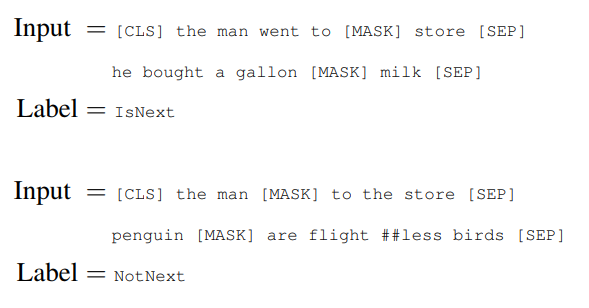
This task can exist easily generated from any monolingual corpus. Information technology is helpful because many downstream tasks such equally Question and Answering and Natural Language Inference require an understanding of the relationship between two sentences.
What downstream tasks can BERT be used for?
BERT can be used for a wide variety of tasks. The ii pre-preparation objectives allow it to be used on any single sequence and sequence-pair tasks without substantial chore-specific architecture modifications.
How is the input text represented before feeding to BERT?
The input representation used by BERT is able to represent a single text sentence as well as a pair of sentences (eg., [Question, Respond]) in a unmarried sequence of tokens.
- The first token of every input sequence is the special classification token – [CLS]. This token is used in classification tasks every bit an aggregate of the entire sequence representation. It is ignored in non-classification tasks.
- For single text judgement tasks, this [CLS] token is followed by the WordPiece tokens and the separator token – [SEP].

- For judgement pair tasks, the WordPiece tokens of the two sentences are separated by another [SEP] token. This input sequence as well ends with the [SEP] token.

- A sentence embedding indicating Sentence A or Sentence B is added to each token. Sentence embeddings are similar to token/give-and-take embeddings with a vocabulary of 2.
- A positional embedding is also added to each token to indicate its position in the sequence.
Which Tokenization strategy is used by BERT?
BERT uses WordPiece tokenization. The vocabulary is initialized with all the private characters in the language, and then the near frequent/probable combinations of the existing words in the vocabulary are iteratively added.
How does BERT handle OOV words?
Any word that does non occur in the vocabulary is broken down into sub-words greedily. For case, if play, ##ing, and ##ed are nowadays in the vocabulary but playing and played are OOV words then they will be broken down into play + ##ing and play + ##ed respectively. (## is used to represent sub-words).
What is the maximum sequence length of the input?
512 tokens.
How many layers are frozen in the fine-tuning step?
No layers are frozen during fine-tuning. All the pre-trained layers along with the task-specific parameters are trained simultaneously.
Is discriminative fine-tuning used?
No. All the parameters are tuned with the same learning charge per unit.
What are the optimal values of the hyperparameters used in fine-tuning?
The optimal hyperparameter values are chore-specific. Just, the authors found that the post-obit range of values works well across all tasks –
- Dropout – 0.ane
- Batch Size – 16, 32
- Learning Rate (Adam) – 5e-5, 3e-5, 2e-five
- Number of epochs – 3, four
The authors also observed that large datasets (> 100k labeled samples) are less sensitive to hyperparameter choice than smaller datasets.
What is the fine-tuning procedure for sequence classification tasks?
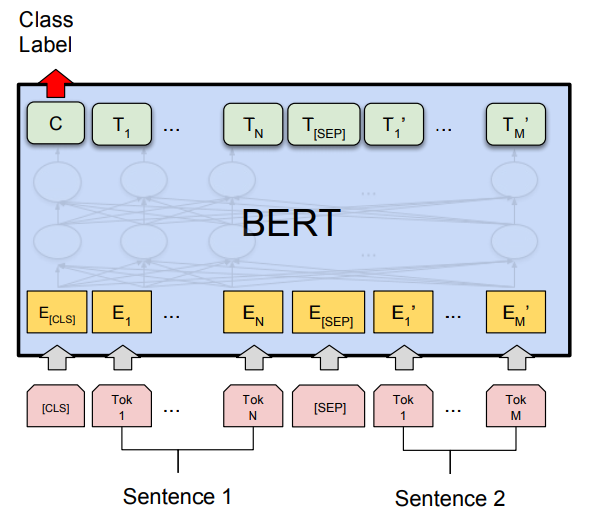
The concluding subconscious country of the [CLS] token is taken as the fixed-dimensional pooled representation of the input sequence. This is fed to the classification layer. The classification layer is the simply new parameter added and has a dimension of Chiliad x H, where K is the number of classifier labels and H is the size of the subconscious state. The label probabilities are computed with a standard softmax.

What is the fine-tuning procedure for sentence pair nomenclature tasks?
This procedure is exactly similar to the single sequence nomenclature task. The simply difference is in the input representation where the two sentences are concatenated together.
What is the fine-tuning process for question answering tasks?
Question answering is a prediction task. Given a question and a context paragraph, the model predicts a start and an cease token from the paragraph that most likely answers the question.

Merely like sentence pair tasks, the question becomes the first sentence and paragraph the second sentence in the input sequence. There are only two new parameters learned during fine-tuning a start vector and an cease vector with size equal to the hidden shape size. The probability of token i being the start of the answer span is computed as – softmax(Southward . K), where S is the start vector and Thou is the final transformer output of token i. The aforementioned applies to the end token.
What is the fine-tuning process for single judgement tagging tasks?
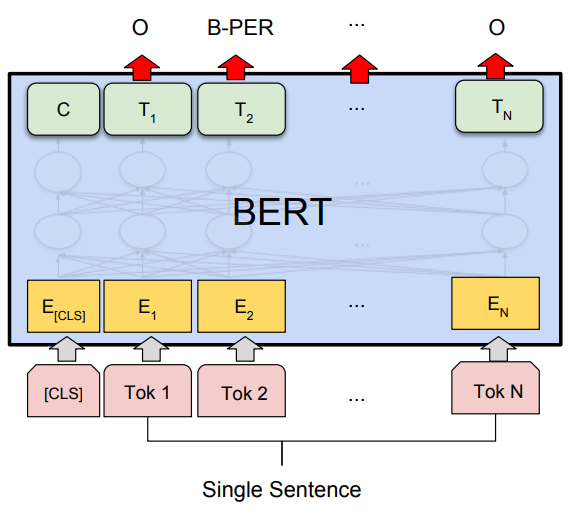
In unmarried sentence tagging tasks such as named entity recognition, a tag must be predicted for every word in the input. The final hidden states (the transformer output) of every input token is fed to the classification layer to get a prediction for every token. Since WordPiece tokenizer breaks some words into sub-words, the prediction of only the start token of a word is considered.
Can BERT be used with tensorflow?
Yeah. The official open sourced code is in tensorflow (GitHub).
Tin can BERT be used with Pytorch?
Yes. Huggingface has open sourced the repository – transformers. It supports the op-to-op implementation of the official tensorflow code in PyTorch and many new models based on transformers.
Tin can BERT exist used with Fastai?
As of now, fastai does not have official support for BERT yet. Simply, at that place are ways we can get around with it. This article demonstrates how BERT can be used with fastai.
Can BERT be used with Ke ras?
Yes. Check this out – BERT-keras.
How to use BERT every bit a sentence encoder?
The concluding hidden states (the transformer outputs) of the input tokens can be concatenated and / or pooled together to go the encoded representation of a sentence. bert-as-a-service is an open up source project that provides BERT sentence embeddings optimized for product. I highly recommend this article – Serving Google BERT in Production using Tensorflow and ZeroMQ.
How does BERT perform when used equally a sentence encoder with a task-specific architecture (similar to ELMO)?
BERT is effective for both fine-tuning and feature-based approaches. The authors did ablation studies on the CoNLL-2003 NER task, in which they took the output from one or more layers without fine-tuning and fed them every bit input to a randomly initialized two-layer 768 dimensional BiLSTM before the classification layer. The all-time performing model was the one that took representations from the top four hidden layers of the pre-trained transformer.
Is BERT available in languages other than english?
Yep, at that place is a multilingual BERT model available every bit well.
Is BERT available on domain specific pre-trained corpus?
Yes. I have come up across Clinical BERT – BERT pre-trained on clinical notes corpus and sciBERT – Pre-Trained Contextualized Embeddings for Scientific Text.
How long does it take to pre-railroad train BERT?
BERT-base was trained on 4 cloud TPUs for 4 days and BERT-large was trained on 16 TPUs for 4 days. At that place is a recent newspaper that talks near bringing down BERT pre-preparation time – Large Batch Optimization for Deep Learning: Training BERT in 76 minutes.
How long does it have to fine-melody BERT?
For all the fine-tuning tasks discussed in the newspaper it takes at well-nigh i hour on a unmarried cloud TPU or a few hours on a GPU.
Thank you for reading. Please experience free to suggest more than questions in the comment section. Your valuable suggestions are always welcome. 🙂
jenningsamens1986.blogspot.com
Source: https://yashuseth.wordpress.com/2019/06/12/bert-explained-faqs-understand-bert-working/
0 Response to "Can Bert Vectors Be Used Outside of Bert"
Post a Comment