Mn Early Learning Math and Reading Standards
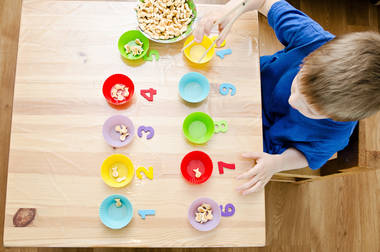
Children are using early math skills throughout their daily routines and activities. This is proficient news as these skills are important for existence prepare for school. But early math doesn't mean taking out the reckoner during playtime. Fifty-fifty before they showtime school, nearly children develop an understanding of add-on and subtraction through everyday interactions. For example, Thomas has ii cars; Joseph wants one. Later on Thomas shares one, he sees that he has one auto left (Bowman, Donovan, & Burns, 2001, p. 201). Other math skills are introduced through daily routines you share with your child—counting steps equally you become up or downwardly, for example. Informal activities like this 1 give children a jumpstart on the formal math teaching that starts in school.
What math knowledge will your kid demand after on in elementary schoolhouse? Early on mathematical concepts and skills that commencement-course mathematics curriculum builds on include: (Bowman et al., 2001, p. 76).
-
Understanding size, shape, and patterns
-
Ability to count verbally (first forward, so backward)
-
Recognizing numerals
-
Identifying more and less of a quantity
-
Understanding ane-to-one correspondence (i.e., matching sets, or knowing which grouping has four and which has 5)
Key Math Skills for School
More avant-garde mathematical skills are based on an early math "foundation"—only like a house is built on a strong foundation. In the toddler years, you can aid your child begin to develop early on math skills by introducing ideas similar: (From Diezmann & Yelland, 2000, and Fromboluti & Rinck, 1999.)
Number Sense
This is the power to count accurately—showtime forward. Then, later in schoolhouse, children will learn to count backwards. A more complex skill related to number sense is the ability to see relationships between numbers—like calculation and subtracting. Ben (historic period 2) saw the cupcakes on the plate. He counted with his dad: "One, two, three, four, five, six…"
Representation
Making mathematical ideas "existent" by using words, pictures, symbols, and objects (similar blocks). Casey (aged iii) was setting out a pretend picnic. He advisedly laid out four plastic plates and four plastic cups: "And then our whole family can come to the picnic!" There were four members in his family; he was able to apply this information to the number of plates and cups he chose.
Spatial sense
Afterward in school, children will call this "geometry." Only for toddlers it is introducing the ideas of shape, size, space, position, direction and move. Aziz (28 months) was giggling at the bottom of the slide. "What's then funny?" his Auntie wondered. "I comed up," said Aziz, "Then I comed downwards!"
Measurement
Technically, this is finding the length, height, and weight of an object using units like inches, anxiety or pounds. Measurement of time (in minutes, for example) also falls under this skill area. Gabriella (36 months) asked her Abuela again and once more: "Brand cookies? Me do it!" Her Abuela showed her how to make full the measuring cup with sugar. "Nosotros need ii cups, Gabi. Fill it up once and put information technology in the bowl, then fill information technology up again."
Estimation
This is the ability to make a skilful judge nearly the amount or size of something. This is very hard for young children to practice. You can help them past showing them the pregnant of words like more, less, bigger, smaller, more than, less than. Nolan (30 months) looked at the two bagels: ane was a regular bagel, ane was a mini-bagel. His dad asked: "Which one would you like?" Nolan pointed to the regular bagel. His dad said, "You must be hungry! That bagel is bigger. That bagel is smaller. Okay, I'll give y'all the bigger 1. Breakfast is coming up!"
Patterns
Patterns are things—numbers, shapes, images—that repeat in a logical way. Patterns aid children learn to make predictions, to empathize what comes next, to make logical connections, and to utilise reasoning skills. Ava (27 months) pointed to the moon: "Moon. Sun go night-nighttime." Her grandfather picked her up, "Yep, little Ava. In the forenoon, the sun comes out and the moon goes away. At dark, the sun goes to slumber and the moon comes out to play. But it's time for Ava to go to sleep now, just like the sun."
Problem-solving
The power to recollect through a problem, to recognize there is more than one path to the answer. Information technology means using past noesis and logical thinking skills to find an answer. Carl (xv months old) looked at the shape-sorter—a plastic pulsate with 3 holes in the top. The holes were in the shape of a triangle, a circumvolve and a square. Carl looked at the chunky shapes on the floor. He picked up a triangle. He put it in his month, then banged information technology on the floor. He touched the edges with his fingers. And so he tried to stuff it in each of the holes of the new toy. Surprise! It brutal inside the triangle hole! Carl reached for another block, a circular one this time…
Math: One Office of the Whole
Math skills are only 1 part of a larger web of skills that children are developing in the early years—including language skills, physical skills, and social skills. Each of these skill areas is dependent on and influences the others.
Trina (18 months erstwhile) was stacking blocks. She had put two square blocks on top of i another, and so a triangle block on top of that. She discovered that no more blocks would balance on top of the triangle-shaped cake. She looked upwards at her dad and showed him the block she couldn't get to stay on peak, essentially telling him with her gesture, "Dad, I need help figuring this out." Her father showed her that if she took the triangle cake off and used a square one instead, she could stack more on pinnacle. She then added two more blocks to her tower earlier proudly showing her creation to her dad: "Dada, Ook! Ook!"
Yous can see in this ordinary interaction how all areas of Trina'south development are working together. Her physical power allows her to manipulate the blocks and apply her thinking skills to execute her plan to brand a tower. She uses her language and social skills as she asks her father for help. Her effective communication allows Dad to reply and provide the helps she needs (further enhancing her social skills as she sees herself as important and a adept communicator). This and so further builds her thinking skills as she learns how to solve the problem of making the tower taller.
What You Can Do
The tips below highlight ways that you can help your kid acquire early math skills by building on their natural marvel and having fun together. (Annotation: Most of these tips are designed for older children—ages ii–three. Younger children tin can exist exposed to stories and songs using repetition, rhymes and numbers.)
Shape up.
Play with shape-sorters. Talk with your child nigh each shape—count the sides, describe the colors. Make your own shapes by cutting large shapes out of colored construction newspaper. Inquire your child to "hop on the circle" or "jump on the cerise shape."
Count and sort.
Assemble together a handbasket of small toys, shells, pebbles or buttons. Count them with your child. Sort them based on size, color, or what they do (i.eastward., all the cars in one pile, all the animals in another).
Place the call.
With your three-year-quondam, begin teaching her the address and phone number of your abode. Talk with your child about how each firm has a number, and how their business firm or flat is one of a serial, each with its own number.
What size is information technology?
Observe the sizes of objects in the world effectually you: That pink handbag is the biggest. The blue pocketbook is the smallest. Ask your child to think about his own size relative to other objects ("Do you lot fit under the tabular array? Under the chair?").
You're cookin' at present!
Fifty-fifty immature children tin help fill, stir, and cascade. Through these activities, children larn, quite naturally, to count, mensurate, add, and estimate.
Walk it off.
Taking a walk gives children many opportunities to compare (which stone is bigger?), assess (how many acorns did we find?), note similarities and differences (does the duck accept fur like the bunny does?) and categorize (see if you can find some cerise leaves). You can also talk about size (by taking big and fiddling steps), estimate distance (is the park shut to our house or far away?), and exercise counting (let'southward count how many steps until we get to the corner).
Picture time.
Utilize an hourglass, stopwatch, or timer to time short (1–3 infinitesimal) activities. This helps children develop a sense of time and to understand that some things take longer than others.
Shape upward.
Signal out the unlike shapes and colors you lot encounter during the 24-hour interval. On a walk, you may see a triangle-shaped sign that's yellow. Inside a store you may see a rectangle-shaped sign that's cherry-red.
Read and sing your numbers.
Sing songs that rhyme, repeat, or have numbers in them. Songs reinforce patterns (which is a math skill too). They besides are fun ways to practice linguistic communication and foster social skills like cooperation.
Starting time today.
Utilize a calendar to talk about the appointment, the day of the week, and the atmospheric condition. Calendars reinforce counting, sequences, and patterns. Build logical thinking skills by talking nearly cold weather condition and asking your child: What do nosotros wearable when information technology's cold? This encourages your child to make the link between cold atmospheric condition and warm wearable.
Pass it around.
Enquire for your kid's assistance in distributing items like snacks or in laying napkins out on the dinner tabular array. Help him give one cracker to each child. This helps children sympathise ane-to-one correspondence. When you are distributing items, emphasize the number concept: "1 for you, 1 for me, 1 for Daddy." Or, "We are putting on our shoes: One, two."
Big on blocks.
Give your child the chance to play with wooden blocks, plastic interlocking blocks, empty boxes, milk cartons, etc. Stacking and manipulating these toys help children learn about shapes and the relationships between shapes (e.g., two triangles make a square). Nesting boxes and cups for younger children help them understand the relationship between different sized objects.
Tunnel time.
Open a big cardboard box at each end to plough it into a tunnel. This helps children understand where their body is in infinite and in relation to other objects.
The long and the short of it.
Cut a few (three–five) pieces of ribbon, yarn or paper in different lengths. Talk about ideas like long and brusque. With your kid, put in order of longest to shortest.
Acquire through touch.
Cut shapes—circumvolve, square, triangle—out of sturdy cardboard. Let your kid bear on the shape with her eyes open and and then closed.
Design play.
Have fun with patterns past letting children accommodate dry macaroni, chunky beads, different types of dry cereal, or pieces of paper in different patterns or designs. Supervise your child advisedly during this activeness to prevent choking, and put away all items when yous are done.
Laundry learning.
Make household jobs fun. Equally you sort the laundry, inquire your child to make a pile of shirts and a pile of socks. Inquire him which pile is the bigger (interpretation). Together, count how many shirts. See if he tin can brand pairs of socks: Tin can y'all accept two socks out and put them in their own pile? (Don't worry if they don't match! This activity is more than near counting than matching.)
Playground math.
As your kid plays, make comparisons based on tiptop (high/depression), position (over/nether), or size (big/little).
Dress for math success.
Ask your child to pick out a shirt for the day. Ask: What color is your shirt? Yes, xanthous. Can y'all find something in your room that is also yellow? As your kid nears three and beyond, observe patterns in his clothing—similar stripes, colors, shapes, or pictures: I see a pattern on your shirt. At that place are stripes that go ruby-red, blue, red, blue. Or, Your shirt is covered with ponies—a big pony next to a niggling pony, all over your shirt!
Graphing games.
As your kid nears three and beyond, make a nautical chart where your child can put a sticker each time information technology rains or each time it is sunny. At the end of a calendar week, you tin can estimate together which column has more or less stickers, and count how many to be sure.

References
Bowman, B.T., Donovan, G.S., & Burns, M.S., (Eds.). (2001). Eager to larn: Educating our preschoolers. Washington, DC: National University of Sciences.
Diezmann, C., & Yelland, Northward. J. (2000). Developing mathematical literacy in the early babyhood years. In Yelland, N.J. (Ed.), Promoting meaningful learning: Innovations in educating early babyhood professionals. (pp.47–58). Washington, DC: National Association for the Educational activity of Young Children.
Fromboluti, C. Southward., & Rinck, Northward. (1999 June). Early babyhood: Where learning begins. U.S. Section of Didactics, Function of Educational Enquiry and Comeback, National Plant on Early Childhood Development and Didactics. Retrieved on May 11, 2018 from https://www2.ed.gov/pubs/EarlyMath/title.html
jenningsamens1986.blogspot.com
Source: https://www.zerotothree.org/resources/299-help-your-child-develop-early-math-skills
0 Response to "Mn Early Learning Math and Reading Standards"
Post a Comment